26 February 2010

Republic to Empire: Basing Plan

Most people who follow this blog know that I have a pretty idiosyncratic basing scheme. I put three 28mm figures on a 40x20mm base in single rank (slightly staggered if possible). I do not believe that I have seen anyone else do this, but it works for me and more importantly it works for the 2 games that I play: Field of Battle and Lasalle.

I have laid out my reasons for my method in a previous blog, but suffice to say I started up my wargaming with a plan to build the two sides at the Battle of Fuentes de Oñoro at a 1:40 ratio figure man ratio and felt that it would be best to use a small as base as possible. I am actually about a third of the way through my master plan having finished a corps aside, which I believe to be a pretty good pace over 3 years. There have been and continue to be distractions, like Walmoden's Korps, Calpe Prussians and now Austrians as well as several new rulesets.

I always realised though that I liked the look of "big battalions" and as noted in my initial blog entry on basing, my bases were designed so the battalions could be easily doubled in size allowing play with 1:20 ratio rule set like Général de Brigade. Well, it is not GdB that we are interested but the new rule set Republic to Empire. I am quite keen to give these rules a go, but this set unlike FoB and Lasalle appears to require much larger battalions than I have painted to date.

I do have a lot of figures painted (well over 1000), so it is should be pretty easy to chase up the 10-15 large battalions that are required in RtE. Although the rules allow for variable sized battalions anywhere from 16-56 figures, generally the average French battalion is 24 figures and the English 32 figures.

In my plan for RtE, I wanted to use the same figure manufacturer within each battalion and additionally had to adjust for the fact that early in my painting career I foolishly bought figures in a firing stance that are great for vignettes but difficult to line up in column of march. I also was not keen to have to move 12 bases for a single battalion, so I had to find some transient method of basing that uses a sabot.

My present bases are fortunately quite thin, 1mm hard plastic, so I had some flexibility. Everyone appears to rave about Litko bases, so I thought I would have a look. They have a lot of different products but what caught my attention was their flexible metal and magnetic sticky bases. I also needed something to stick the sticky strip on and their 0.8mm plywood bases were perfect. We already have enough problems in 28mm gaming with vertical scale. I am not really keen on thick bases, I find the 3mm Litko bases already a little too thick.
So here we have a 40x20mm 1mm plastic base with a precut 40x20 sticky flex steel base attached, still pretty low profile. Bit of paint and we are done.
I then made a sabot out of a 40x50mm 0.8mm plywood base with a the same sized HD flex magnet base stuck to it. I initially tried the regular strength magnet, it would not hold metal figures.
As you can see it has a pretty low profile as well. I went with an extra 10mm depth to make it possible to mount all those firing pose figures I have.
I am trying 2 different terraining techniques, clearly the one on the left looks better, but I wanted some sabots that had terrain with no relief so I could stick on labels to indicate the unit designation and it's stats. I just find it hard to read the flags and the facings in a game.
The magnetic strength was quite satisfactory for plastic figures, but would it work for metals?
Here are some Perry metals. Seems to work.......but how about the big boys?
Here are some chunky Front Rank........success!
Here is a 30 figure British battalion. The unit sticker will be affixed to the command stand.
and a 34 figure battalion.
A 24 figure French battalion. Not sure if I really need to use a sabot for the mounted officer base.
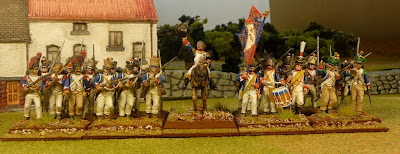
A 34 figure French battalion.
So generally I am pretty pleased and believe the scheme works. I have photographed the sabots from their worst angle. On the table looking from above they look pretty good. With the sabot the base is around 3mm thick.

I know, of course, that rebasing would look much better but I believe the solution is not too bad.
(14572)

17 February 2010

Army Painter: Austrians (new photos)

I know I said I was doing Prussians next, but I have been considering how I am going to paint white. I do not believe I am patient enough to use something like the Andrea white system. The other day I came across some Army Painter, so I said why not. I finally figured out how to set the white balance on my camera so I am reposting my photos, these photos are not retouched. These 9 Front Rank Austrians were painted in well less than 2 hours, which I believe to be a pretty good clip. Forgot to paint the buttons yellow in first photo.
Army Painter Quickshade Strong Tone. This is actually quite dry.
Testor's Dullcote. Really takes the shine off.
With (left) and without Dullcote.
I like what I see, but I may test the the Quickshade Soft Tone.

I apologise to those who put some comments on the earlier post, but those photos just had to go.

(14195)

11 February 2010

Evolution of Hanoverian OOB 1813-16

I have been trying to paint the up the Hanoverian-British division of Walmoden's Korps at the Battle of Gohrde 1813. This is a pretty obscure unit and it is quite difficult to find information about the uniforms and to source figures. I decided to go with some Perry Hanoverians, although I know these are for their 1815 line. The uniforms would have changed significantly over this period of time, but what of it and I can use them maybe for some Waterloo project in the future.

To be fair though, I said I would trace back the 1815 units to their parent units as they were formed from 1813 onwards. This ended up being a pretty obscure area of scholarship. After several hours on the net and looking through some books I have, the following table evolved:
I used a number of references as note above. I have the Osprey Men at Arms 206 on the Hanoverian army and that is where I got some of my basic information for 1813, I also had researched the OB for the Battle of Gohrde in an earlier post. I also used some references from the following links as listed above: the Napoleonic Series, Gen de Brigade forum, a nice clickable reference to the Battle of Waterloo OOB, the Mont St Jean site and this pamphlet by WJ Rawkins. I also used Siborne's well known uniform table as follows, although there is some debate about it's accuracy.
(13827)

10 February 2010

Nous venons, Archiduc.......nous venons.....

Général de division Friant, Générals de brigade Gilly, Pajol and Grandeau with elements...................of the 3e and 5e régiments des Hussars and 11e and 15e régiments des Chasseurs à Cheval.

The cavalry and the 2 GdB on the left are Front Rank and the GdD and the GdB on the right are Perry. All very nice figures, highly recommended. More to come soon at Clash of Empires.

(13760)

07 February 2010

What's Next? The Prussians are coming: Prussian OOB

With the completion of the French VI Corps, it is time to move on to something completely different. I was planning to start 1809 Austrians, but with Victrix coming out with Austrians sometime in the future, I felt I should wait before committing myself to the force composition. I am also still trying to figure out how to paint white and have ordered some Front Rank Austrians to get in some practice.

I am presently working on some Perry Hanoverians for my Walmoden's Korps project, hopefully completing Division Lyon (British-Hanoverian) in the next month or so. This project though has always been a piece of historical research, rather than something with which I plan to game.

The lure of Calpe figures has always been irresistible to me and I had been awaiting Martin Kelly's article in Wargames Illustrated on Prussian Army organization for some months and it finally came last week. With this excellent information and the Army Builder in Lasalle, I just could not resist any further.

Using this excellent site which gives the brigade organisation for the Prussian Army in the summer of 1813, I was able to pick the following unit.


The army builder in Lasalle is great and I believe is quite accurate historically, but I can not be excited about painting a generic unit. What I plan to do henceforth is to take an historical unit and paint it as I have been doing in the past, but at the same time construct a Lasalle core unit. It just happens that the Prussian list exists as a free download on the Honour website, and as you can see this historical unit is very close to the core Prussian unit when it is the attacker. There are two too many infantry battalions, the cavalry should be landwehr and I had to add some skirmisher bases. The excess infantry of course will contribute to some future Organic Prussian brigade and who could resist the famous "Death's Head Hussars" or a few Schuetzen. The one problem is that Calpe does not appear to have grenadier figures (I do not believe they are significantly different, but I need to do a little more research), so I substituted a Fusilier battalion.

More to come.........Befreiungskriege indeed.

(13620)

04 February 2010

VI Corps: French Army of Portugal

There we are, finally. The corps as it was at the Battle of Fuentes de Oñoro. There are around 375 standing figures, 11 mounted regimental colonels, 8 cavalry figures, 3 cannon, and 11 mounted command figures. The ratio is just over 40 men to 1 figure , thus representing over 17,000 soldiers. They represent 34 infantry battalions, a cavalry brigade and 3 divisional batteries. The corps takes up 18"x30" on the terrain.
Maréchal Massena, followed by le général Louis Henri Loison with their ADC's.
(13456)

31 January 2010

Peninsular War: French Army of Portugal: 6th Corps, 1st Division, May 1811

Jean Gabriel Marchand the general de division. Here represented by a Front Rank figure with a Redoubt ADC in blue. Brigade Chemineau comprising the 39e ligne (1190 men). A small regiment with a mixture of Perry plastics and Elite command figures, although 3 battalions where at the Battle of Fuentes de Oñorno, I have represented with just 2 here. These figures are just off the painting table, maybe a little sloppy but since this was the last unit in the 6th Corps to be painted, I was getting a little fed up.
and 76e ligne (1290 men). Ditto as above in respect to figures, painted about 6 months ago. General de Brigade Chemineau is a Redoubt figure (say it again, avoid these figures).
Brigade Maucune with 69e ligne (1590 men). Foundry figures painted a couple of years ago, thank god we all can learn. General de Brigade Antoine Maucune is a Front Rank figure.
and the 6e legere (1250 men). Foundry figures done about a year ago.
Well that it for the 6th Corps, I shall post some snaps of the whole unit in a day or 2.

(13260)

24 January 2010

Peninsular War: French Army of Portugal: 6th Corps, 2nd Division, May 1811

The 2e Division was led General Mermet. The numbers listed are the number of men fielded at the Battle of Fuentes de Oñoro in May 1811. Three quarters of the unit is comprised of Foundry figures. General Mermet's stand has a Front Rank figure representing the General and a Redoubt figure the ADC, it will be eventually replaced by Perry. The Redoubts are nasty little figures, but it is what I had at hand when I did the stand.
The generals de brigade are a Front Rank on the left and another Redoubt on the right, also to be replaced by a Perry figure in the future.
Brigade Ménard:
1e,2e,4e/25e Régiment Légere (1870 men), these are Foundry figures painted about 2 months ago well described in a previous post.
1e,2e,4e/27e Régiment de ligne (1810 men), painted about 3 years ago, it is good to see that you can improve your painting.
Brigade Taupin:
1e,2e,4e/50e Regiment de ligne (1410 men). These are of course Victrix. Occasionally I buy painted figures and about 2/3 of this unit was done by Martin Evans. His whites are absolutely stunning as you can see below. My figures of course are the undifferentiated whites, but otherwise I feel they came out well. I still had problems getting the arms glued on straight.
1e,2e,4e/59e Régiment de ligne (1600 men), ditto as the 27e.
Well it has been quite a long journey, almost 3 years when I decided to paint a corps each of British and French for this battle. I have 2 more French and 2 more British battalions to paint to complete the goal I had set for myself at the time. I will be happy to move on to some different armies, but I feel I have learned a lot about painting.

(12900)

18 January 2010

Perry Plastics: British Line

It has been a long time since my last post. Xmas was busy with visitors, work and well Xmas. Just after the New Year, I was able to start on a new battalion. I had been planning to finish off the French infantry for the VI Corps in the Army of Portugal, but I was getting tired of blue. This box had been sitting around for a while so I thought I would give it a go. I needed some KGL line to finish off Wellington's 1st division in his Army of Portugal. These 4 battalions are a bit of a challenge as they were quite small, with a total of 1800 men all told. I decided to base these 40 figures as 2 large Lasalle units of 6 bases each, this is pretty close to a figure ratio of 1 figure to 40 men.

The figures were quite easy to assemble and of course were primed white. Ninety percent of each figure was done using washes (both GW and Foundry), only the metal and the facings were done with acrylic paints. Two coats of wash were done at the most, so they were painted quite rapidly, I would say 30 minutes for each figure including basing. I am quite pleased with result. These are very nice figures, I was able to fit 3 on a 40x20 mm base without too much problem. They will be my British line figures of choice from henceforth.

I present them here as the 34 figure 1st Battalion KGL line. The large battalions do look nice, but I would be painting forever to build corps where the battalions are this size. I am thinking about scaling back to divisions, but more about that at another time.
Light company.
Grenadier company.
Two companies of Light KGL deployed as skirmishers. I again used a GW wash, maybe a little "bright green" in the photo. They do look good on the table.
I plan to break this unit in 2 as noted above and add a 40x40 mm command stand with a mounted Colonel, a second ensign and another drummer. These are already done with Front Rank figures, I cut the heads off (they had belgic shakos) and glued on some excess heads from the box. Maybe very slightly microcephalic looking, but I do not believe that anyone would notice unless told.

(12600)

13 December 2009

Torrecastro a ramené

I thought I would have another go at the same scenario with the same ruleset to see how long it would take. The game took 3 hours over 2 sessions, with some referral to the Lasalle Forum. This is very good for solo wargaming. I also wanted to see if I could manage the French attack a little better. This time I planned on the same British defensive posture but a more cautious French attack with more reliance on artillery rather than immediate combat. Lets see how it goes.
turns 1-6
Both armies starting position can be seen here. Both armies advance toward each other, the 88th forms into march and advances through the 5th. The RFA unlimber. The British jockey their lines and the French form into march formation to speed their advance. The French artillery moves within canister range and unlimbers.
turn 7
The French veteran bde advances toward the British left and the 6e Dragoons start their move towards the 88th.
turn 8
RFA fire causing 1 DISR on the 6e Dragoons. The 88th forms line.
turn 9
The French cannon fire canister at the 88th causing 1 DISR. The French veteran bde forms into attack column as does the conscript bde. The 6e dragoons form into wave formation.
turns 10 & 11
The RFA fire causing further damage on the 6e dragoons. The 88th fire at the 25e causing DISR as does the 45th on the 1/66e ligne. Recovery tests fails.
The French fire back without success. The 25e légere charge the 88th, so do the 1/66e on the 45th. The 6e Dragoons wheel and charge the RFA. The 2/66e forms line. The conscript bde changes their formation as well. The French artillery prolong toward the right of the British line.
turns 12 & 13
Multiple contact along the British line. The RFA decides to fire rather than seek refuge, no hits. The 88th falls back as a reaction. The RFA are broken by the 6e dragoons who fall back with 1 DISR. The combat between the 45th and the 1/66e is inconclusive with the 1/66e falling back 2BW and taking 1 DISR.
The French press their attack with cannon fire, the 2/66e advance in line. The 1/66e charge the 45th again, as do the 25e légere on the 88th, "les grognards" are relentless. The 6e dragoons wheel and take the 88th in the flank. The 3/59e ligne advance towards the 5th. The 26e ligne form line.
turns 14 & 15
The 45th break the 1/66e. The 88th is unable to form square in reaction to the charge of the 6e dragoons. They first engage in combat with the 6e dragoons, then the 25e. The dragoons break and the 25e légere fall back with 1 DISR. The invincibility of the Devil's Own is again demonstrated.
The 2/66e, artillery and the 25e fire at the British with success. The 26e and the 3/59e miss. The French adjust their formations and positions as seen below. The 25e légere, French artillery and the 26e ligne all are in line taking aim at the 88th, who have 3 DISR. Will the 88th stand!
turns 16 & 17 (bonus)
The 88th fire at the 25e and they break. The 2/66e loses 1 more DISR.
The French in their first bonus turn fire their canister at the 88th and they finally break!! The 2/66e and the 3/59e cause DISR. The French artillery prolong towards the centre on the British line. French still have not reached their breakpoint, so no morale test.
turns 18 & 19 (bonus)
The 45th and the 5th cause damage to the forward French infantry. The British decide that it is best to attack the the French artillery, if the French keep on getting bonus turns the French advance will succeed. The 74th advance in line and the 94th make a flank move to cover the gap in the British centre. The British are at exactly 33% of their breakpoint, so no morale test.
The French are again successful in their bonus die. Their units fire and all cause DISR to the forward British units.
turn 20
Die toss fails, game over. The French fail to capture Torrecastro, so a British victory but with cost.
Summary
Much better game, maybe I should have increased the number of regular turns because of the size of the table as I think the French would have eventually won. I was much more comfortable with the rules this time. They are good!! Mais assez de Torrecastro.

(11107)