Here are the command stands for my Brunswick Corps with a couple of new basing ideas. First up is the my new divisional stand: A 80x50mm oval. I realized the number of figures I would need for my Napoleonic command stands was just too many, and I also felt the 120x80 mm stands were too big for this level of command. I will stay with this rectangular stand for the Corps and Army command bases ie commands of 12-20k men. For under 12k men, ie. 2-4 brigades, I thought this oval stand looked a lot better and was more appropriate in size for the table. There is also a 50 mm round brigade stand in this collection as well as another new addition, an ADC stand. These 50x25mm ovals will be used for my functional ADC's, ie chaps who have to move about the terrain. FoG Napoleonic ruleset has this as a function and Curt's upcoming ruleset Food for Powder uses them as well. I have always thought that having ADC's running about the terrain would be cool.
Showing posts with label Basing. Show all posts
Showing posts with label Basing. Show all posts
14 February 2013

30 December 2012
Advice Sought!
Had a bit of a delay there for a while, lost 3 days over Xmas.......Lost Holiday!......I suppose. But back on track now, finished another 160 points for the contest, just need to get the bases done.
25 April 2010
A Fit of Madness
Where are the Austrians.............where are the Prussians? Well I got waylaid. You may have noticed that that in my most recent post, I described the Austrian units as being 24-36 figures. Followers of Wargaming in 28mm will know that my standard unit is 12 figures (4 bases), with some adjustment for historical OB. Well if you go back to my very early posts (the second I believe), my initial basing plan was one which would allow me double the size of my units at some unspecified future time. Well that time has come, thus the delay in my painting all those new armies.
 The British were a bit more of a challenge and as you can see below it is a work in progress, figures had to be moved about, facings had to be repainted and there is some reterraining of bases to do. I am also doing some re-flaging, as unfortunately many of my GMB flags faded (they were purchased in 2008, the year of the great fade); Grahame Black has been very decent about this and has offered to replace gratis the faded flags.
 As you can see, I have ended up with 14 British battalions varying from 4-6 bases. I have to do a little extra painting as well (maybe a total of 25 figures). This was somewhat of a challenge as I am a much better painter now than I was 3 years ago when some of these units were painted. It is well worth it though as now my British battalions will finally fly both the King's and their regimental colours.
 Unfortunately, the 5oth, 43rd, 83rd, 45th, 74th and 42nd have all lost their commands, they do look a little lonely below. I have assured the colonels of the 42nd and the 43rd (need more elite units) that they will be back in service by the end of the year.
 I also have changed my cavalry units bases from 40x40 to 40x50mm. I have quite a few cavalry and did not want to rebase them, I glued a 0.8 mm Litko base to the existing base and did a little terrain fix-up. As you can see they came out quite well.
 Well I hope to get to those Prussians and Austrians soon.........
Why now you ask? Well there is a number of reasons, I have painted around 35 battalions of French and a similar number of Anglo-Portuguese for my peninsular campaigns. I realised that I really did not need this many units to play most scenarios at the battalion level. The rules I play, FoB and Lasalle both are base dependent sets, while RtoE is more figure dependent. I like all 3 sets and I suspect that I will continue to play all 3 depending on the occasion. I also was growing more and more enamoured of the large battalions. Fortunately, it was quite easy to convert the smaller battalions to the large battalions by the use of magnetised sabots. This of course allows me to go back to my earlier scheme if I want to play a game of Lasalle or FoB involving many more troops as I plan to keep the excess command stands ready.
My next decision was to decide on how many bases should make up each battalion. I like to generally keep with historical OB's, but at the same time I have told myself to be a little less obsessive about this. Many rulesets require specific base sizes, etc, etc ..........these are just stupid and reading TMP is always good for a laugh when they all go on out base size this and base size that.......What I like about Lasalle and FoB, is that there is no required base size and both of them allow to some extent for a variable number of bases. Their only requirement is that the same basing be used for each army; who can complain about that. RtoE is also base size independent, but is interestingly enough also is base independent, but unlike Lasalle and FoB is figure dependent. You need a minimum of 20 figures for small battalions and up to 52 figures for very large battalions (generally recommended a 1:20 figure ratio).
So taking all this into account (as well as the fact that I am painting multiple armies) and after much thought, I decided to go with 3 different battalion compositions generally based on their individual historical OB. All my battalions will be comprised of 4, 5 or 6 bases. This allows for some of the small British units in the Peninsula and small French units in the 100 days, as well as the large British Guard units as well as those immense Austrian battalions. I probably should have 8 bases for the Austrian 1000+men battalions, but I believe both Lasalle and FoB rulesets will break down if units with this many bases are fielded. I suppose I just could have gone with 4 or 6 bases units, but there are those in between sized battalions (700men) that are just not small or large. So the scheme is generally as follows:
- Small Battalions (400-650 men)---------4 bases
- Medium Battalions (650-850 men) ------5 bases
- Large Battalions ( 850-1000 men) -------6 bases
I believe this will end up as a generally a 1:25 figure ratio. The great majority of the 40x40mm bases will have 6 figures (made up of 2x40x20mm bases with 3 figures) in 2 ranks, but some 40mm square bases will have a 3 figure British command unit and some of the 20x40mm bases will have 2 elite figures (light) to allow them to break off to skirmish (a neat thing about the RtoE rules). My original 3 figure bases easily allowed all this to happen.
I ended up with 12 French battalions with no work aside from sticking a flexible metal strip to the original base. These are mostly 24 figure 4 base units, aside the 9th legére that made it up to 5 bases. I can squeeze I believe 1-2 more units from my existing battalions, but I have to do a little bit of extra repainting. I will keep all the command stands intact, so I can easily change the unit designation depending on the historical OB. There are also a few extra bases which can act as the nidus of new battalions. Very easy the French.
 The British were a bit more of a challenge and as you can see below it is a work in progress, figures had to be moved about, facings had to be repainted and there is some reterraining of bases to do. I am also doing some re-flaging, as unfortunately many of my GMB flags faded (they were purchased in 2008, the year of the great fade); Grahame Black has been very decent about this and has offered to replace gratis the faded flags.
 As you can see, I have ended up with 14 British battalions varying from 4-6 bases. I have to do a little extra painting as well (maybe a total of 25 figures). This was somewhat of a challenge as I am a much better painter now than I was 3 years ago when some of these units were painted. It is well worth it though as now my British battalions will finally fly both the King's and their regimental colours.
 Unfortunately, the 5oth, 43rd, 83rd, 45th, 74th and 42nd have all lost their commands, they do look a little lonely below. I have assured the colonels of the 42nd and the 43rd (need more elite units) that they will be back in service by the end of the year.
 I also have changed my cavalry units bases from 40x40 to 40x50mm. I have quite a few cavalry and did not want to rebase them, I glued a 0.8 mm Litko base to the existing base and did a little terrain fix-up. As you can see they came out quite well.
 Well I hope to get to those Prussians and Austrians soon.........
(17789)
26 February 2010
Republic to Empire: Basing Plan
Most people who follow this blog know that I have a pretty idiosyncratic basing scheme. I put three 28mm figures on a 40x20mm base in single rank (slightly staggered if possible). I do not believe that I have seen anyone else do this, but it works for me and more importantly it works for the 2 games that I play: Field of Battle and Lasalle.
I have laid out my reasons for my method in a previous blog, but suffice to say I started up my wargaming with a plan to build the two sides at the Battle of Fuentes de Oñoro at a 1:40 ratio figure man ratio and felt that it would be best to use a small as base as possible. I am actually about a third of the way through my master plan having finished a corps aside, which I believe to be a pretty good pace over 3 years. There have been and continue to be distractions, like Walmoden's Korps, Calpe Prussians and now Austrians as well as several new rulesets.
I always realised though that I liked the look of "big battalions" and as noted in my initial blog entry on basing, my bases were designed so the battalions could be easily doubled in size allowing play with 1:20 ratio rule set like Général de Brigade. Well, it is not GdB that we are interested but the new rule set Republic to Empire. I am quite keen to give these rules a go, but this set unlike FoB and Lasalle appears to require much larger battalions than I have painted to date.
I do have a lot of figures painted (well over 1000), so it is should be pretty easy to chase up the 10-15 large battalions that are required in RtE. Although the rules allow for variable sized battalions anywhere from 16-56 figures, generally the average French battalion is 24 figures and the English 32 figures.
In my plan for RtE, I wanted to use the same figure manufacturer within each battalion and additionally had to adjust for the fact that early in my painting career I foolishly bought figures in a firing stance that are great for vignettes but difficult to line up in column of march. I also was not keen to have to move 12 bases for a single battalion, so I had to find some transient method of basing that uses a sabot.
My present bases are fortunately quite thin, 1mm hard plastic, so I had some flexibility. Everyone appears to rave about Litko bases, so I thought I would have a look. They have a lot of different products but what caught my attention was their flexible metal and magnetic sticky bases. I also needed something to stick the sticky strip on and their 0.8mm plywood bases were perfect. We already have enough problems in 28mm gaming with vertical scale. I am not really keen on thick bases, I find the 3mm Litko bases already a little too thick.
 So here we have a 40x20mm 1mm plastic base with a precut 40x20 sticky flex steel base attached, still pretty low profile. Bit of paint and we are done.
 I then made a sabot out of a 40x50mm 0.8mm plywood base with a the same sized HD flex magnet base stuck to it. I initially tried the regular strength magnet, it would not hold metal figures.
 As you can see it has a pretty low profile as well. I went with an extra 10mm depth to make it possible to mount all those firing pose figures I have.
 I am trying 2 different terraining techniques, clearly the one on the left looks better, but I wanted some sabots that had terrain with no relief so I could stick on labels to indicate the unit designation and it's stats. I just find it hard to read the flags and the facings in a game.
 The magnetic strength was quite satisfactory for plastic figures, but would it work for metals?
Here are some Perry metals. Seems to work.......but how about the big boys?
 Here are some chunky Front Rank........success!
 Here is a 30 figure British battalion. The unit sticker will be affixed to the command stand.
 and a 34 figure battalion.
 A 24 figure French battalion. Not sure if I really need to use a sabot for the mounted officer base.
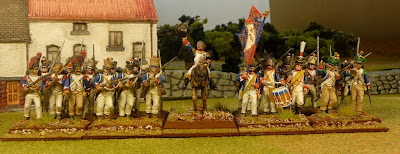 A 34 figure French battalion.
 So generally I am pretty pleased and believe the scheme works. I have photographed the sabots from their worst angle. On the table looking from above they look pretty good. With the sabot the base is around 3mm thick.
 Here are some chunky Front Rank........success!
 Here is a 30 figure British battalion. The unit sticker will be affixed to the command stand.
 and a 34 figure battalion.
 A 24 figure French battalion. Not sure if I really need to use a sabot for the mounted officer base.
 A 34 figure French battalion.
 So generally I am pretty pleased and believe the scheme works. I have photographed the sabots from their worst angle. On the table looking from above they look pretty good. With the sabot the base is around 3mm thick.
 I know, of course, that rebasing would look much better but I believe the solution is not too bad.
 (14572)
 (14572)
01 August 2009
What a mess...what a mess...


In a recent post's comments, I said I was going to start to post photos, a division at a time, of my figures completed to date. The above photo show all the Anglo-Portuguese units I have now painted. I started painting on a regular basis 3-4 years ago. At the time, I decided to attempt to paint the forces, at around a 1:50 figure ratio, that were present at the Battle of Fuentes de Oñoro in May 1811. This was a pretty ambitious project and I am surprised that I am about maybe a third of the way there.
Above are the Third, Light, First and Cotton's Cavalry divisions, aside from the Scots Guards and 2 regiments of cavalry, which are still left to do. All the command figures (Wellington, the divisional and brigade stands) and artillery are also done.
Looking back now, though I realise there are many problems. It is amazing how little I knew at the time about uniforms. The most glaring error is that the is that they are all in Belgic shakos!!!! Also I bought figures with a firing pose which are a nightmare to pose on the small bases I like. They look good on the base, but are difficult to align into march column. Certainly too late to change out the figures.
It is also interesting to look at my painting style. At the time I use a black undercoat and was a very poor block painter with some elementary shading. I did not appreciate the subtleties of the detail on the figures and never painted in the muskets etc. properly. Well I do not think that I am going to repaint them and they do document the evolution of my painting ability (my wife says I have improved greatly; I do not show her the photos of some of your work!).
Another problem is that I switched from basically Foundry figures to Front Rank figures somewhere along the way. If I remember correctly, I think it was because of the way that Foundry command figures were packaged. When I started to paint the Front Rank's, I liked them and started to buy their basic infantrymen. Somehow or another, I ended up mixing the figures together within the battalion unit. I think I will fix this as much as I can by moving around the figures and repainting the appropriate facing as needed. This I hope will not be too big a job.
I am also going to slightly change my basing scheme. My original thoughts on basing has changed. I am ok with the everything I originally planned, except the the British Infantry battalions. I think now that I will increase the unit size to 14-15 figures (5 bases) from 11-12 (4 bases) figures. You may notice that all my British infantry battalions have an integrated mounted officer while my French units have the mounted officer at the regimental level (3 battalions). The British units look lopsided with one 40x40mm base and three 20x40mm bases. I realise the 3 figure 20x40mm base is not the norm and that most of you use 4 figure square (40,45 or 50mm) bases. I am not really in to creating mini-dioramas so I feel my scheme is more historically accurate, ie. it gives a thinner looking line. I can also suck this up historically as the British arrayed themselves in lines of 2 deep, while the French were 3 deep. Therefore I think it reasonable that my British Battalions when in line are 200 mm wide, while the French are 160mm wide for units with generally the same number of men (500-600).
So how shall I start? Well, I am going to have to raid some of the infantrymen of the 4 battalions of KGL line to build up the other British units to 5 bases and to make the battalions uniformly either Front Rank or Foundry. I hope this is not too much work. In the end I can order some new figures for these units with stovepipe shakos and they should stand out nicely.
I also still want to adhere to some historical orders of battle for my units, so I am still not sure how many figures I will use in the large Guard (Coldstream and Scots)and Light (52nd) infantry units. I would appreciate any suggestions.
16 August 2008
Scales and Basing
Scales, basing and figure manufacturers appear to be an area of much discussion in the Napoleonic wargaming world. Just search any of these words on The Miniature Page website. There appears to be no end of debate and aside from choice of rules, nothing at times seems so much acrimony among the war-gamers.
So after much thought and knowing I was going to get it wrong (or at least knowing that 50% of the wargaming community would disagree), I decided to go with the following. This was influenced by several decisions I had already made.
First, I was going to go with 28 mm figures because I like to paint and that was the main reason I had started the hobby. I did, however, want to war-game and knowing that the figure size was a primary determinant of the table size needed, I was going to have to jam as many figures as possible on the smallest base that I could. It seemed that war-gamers with 28 mm figures had 20x16 foot tables and I was never going to be able to fit a table that size that in my attic, thus the drive to use as small a base as possible. The third factor was that I wanted to get the unit divisions done as soon as possible and had decided on a 1:50 figure ratio, I wanted to maneuver battalions and the Le Feu Sacre rules seemed the best for me. Finally the look of it was important to me, I did not want to have units in line that looked square on the terrain, so I decided on single rank basing. With this and at least 4 bases for each infantry unit, I could easily form and more importantly be seen to form line, column and square. Cleverly this allowed me in the future to change the figure ratio to 1:20 (General de Brigade rules set) by just doubling the number of bases and arraying them behind each other essentially to end up with a double ranked figures (A long way off I suspect).
Infantry Basing: I found that most infantry battalion units were going to be 10-16 figures, so to get a minimum of 4 bases it was obvious that I would have to fit 3 figures to each base. Simple experimentation revealed that the appropriate base was to be 40 x 20 mm. I had also decided to base light troops on the same sized base but in 2 figures rather then 3, thus being able to detach them as skirmishers. Command stands were a bit of a challenge, as I wanted to use mounted figures as the colonel in chief, and one can not fit a horse on a 20 mm deep stand, so I had to use a 40 x 40 mm stand, with the flag bearer and the musician on the same stand. So each British or Portuguese battalion ended up having 3-6 (depending on the size of the battalion) 40 x 20 mm bases with one 40 x 40 unit command stand. I did something slightly different with the French units, as I wanted their mounted colonel to represent a regiment rather then a battalion. Look at the orders of battles for French units and you see that unlike the British, 3-4 infantry battalions of the same regiment were grouped together. So the regimental colonel was represented by a single mounted figure on a 40 x 40 mm stand. The Chef de Batalion was represented on a 40 x 20 mm stand with the flagbearer and musician. Otherwise the French Infantry units were based exactly the same (the one basing requirement of all rule sets) as the British units on 40 x 20 mm stands (French units were more uniform in size so in most cases the a battalion was represented by 4 stands, with 3 figures on each stand aside from the elite companies like the voltiguers represented by 2 figures per 40 x 20 mm stands)
Cavalry Basing: Easy, 2 horses on each 40 x 40 mm stand, with the unit command figures integrated into the unit. Most cavalry regiments are made up of 4 stands in my army (400 men)
Artillery Basing: As much as I tried I could not get an artillery piece on a 40 x 40 mm stand with figures so I opted for 50 mm square stands with the number of figures representing the number of guns, i.e. each figure representing 2 guns. In most cases, each artillery battery has 6 guns. Most of my artillery units (batteries) are therefore on 50 x 50 mm bases, with 1 cannon and 3 artillerymen.
Command Basing: In the Le Feu Sacre ruleset, army, corps, division and in some cases brigade commander stands are critical. I used a pretty simple scheme:
Army commanders are 3 mounted figures on a round 50 mm in diameter stand (see Wellington and Massena above)
Corps commanders are 2 mounted figures on a 50 x 50 mm stand (see Loison above)
Divisional commanders are 1 mounted and 1 standing ADC on a 50 x 50 mm stand (see Crauford and Picton above)
Brigade commanders are 1 single mounted figure on a 50 x 50 mm stand (Beckwith is with his horse, try to find a mounted 95th rifles officer out there)
Subscribe to:
Posts (Atom)